


KEEP THE TIRES.
ADD THE TRACKS.
A steel track that wraps over the tires your skid steer already has. It grips in mud, snow and loose rock, carries the machine over soft ground, and comes off again when the job is back on pavement.
THE GRIP OF A TRACK MACHINE. THE LOADER YOU ALREADY OWN.
A wheeled skid steer is quick and cheap to run until the ground turns soft. OTT tracks give it the days back that rain, snow and mud would take, without buying a second machine.
Steel bars bite into mud, snow, ice and loose rock, so the machine keeps pushing where bare tires dig themselves in.
The track bridges both tires and carries the machine on one long footprint, so it stays on top of soft ground.
There is steel between the tire and the ground. It takes the cuts from rebar, sharp rock and stumps that would put a tire flat.
A longer, wider footprint with the weight carried low. The machine feels planted when you work across a hill.
An OTT track is an attachment, not a rebuild. Once you have done it before, plan on about 15 to 20 minutes a side. Allow longer the first time.
WHERE STEEL OTT EARNS ITS KEEP
Steel is for off-road work. It is at its best on the ground that stops a wheeled machine, and it is hard on finished surfaces. Know which side of that line your job is on.
- Mud, wet clay and soft fields
- Snow and ice
- Loose rock, demolition debris and scrap
- Land clearing and forestry
- Side slopes and uneven ground
- Finished concrete and asphalt: steel marks the surface, most of all when you turn
- Lawns and turf you have to hand back in one piece
- Long runs on a hard road
- Indoor and finished floors
If most of your hours are on pavement, a steel OTT track is the wrong tool. Call us and we will say so.
FOUR PARTS DO THE WORK
Up close, a steel OTT track is simple: a pad under the tire, a guide up each side of it, and links that bolt one pad to the next.
One steel pad per link sits across the tread. The bar on its ground side is the part that grips.
A plate runs up each sidewall and keeps the track centred on the tire, including on a side slope.
The track is a chain of separate links. A bent or worn one comes out on its own; the length is set by adding or removing links.
The gaps between the bars let mud and stones drop out as the track rolls, so it keeps biting instead of packing solid.
FIVE STEPS FROM PARTS TO TRACK
The track is a row of identical links, bolted and pinned with hand tools. These renders follow two of them from loose parts to a locked joint. The rest of the track repeats it.
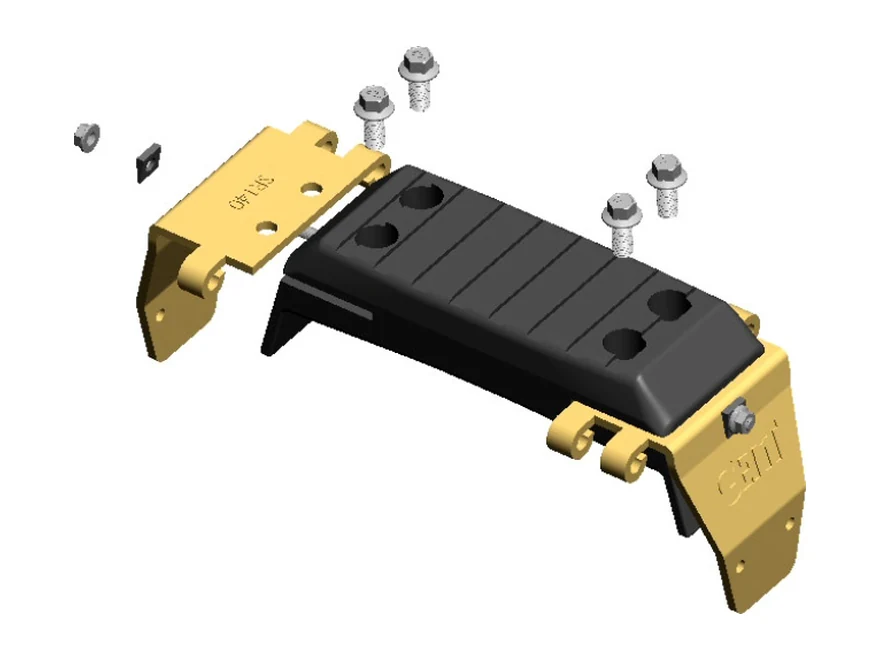
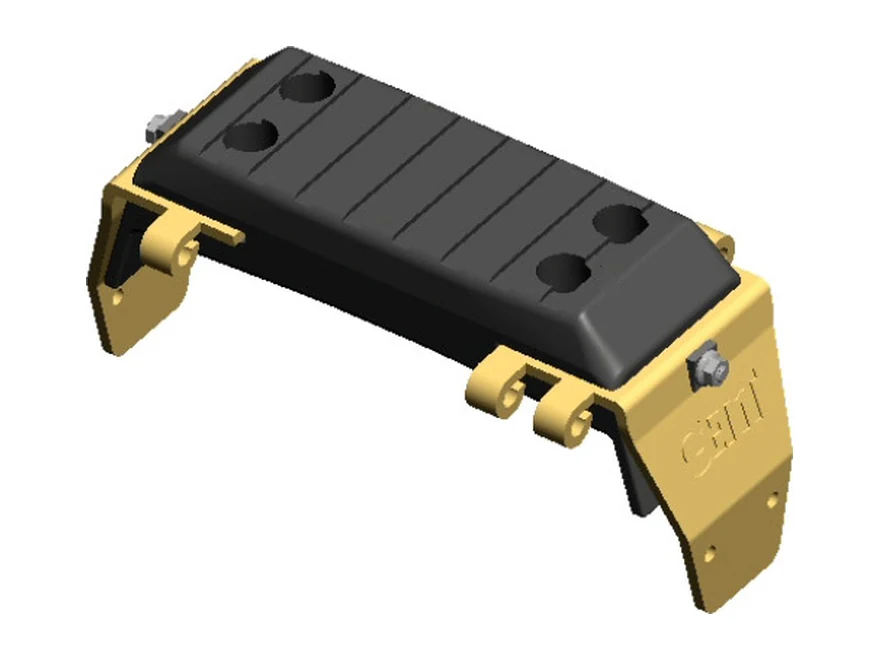
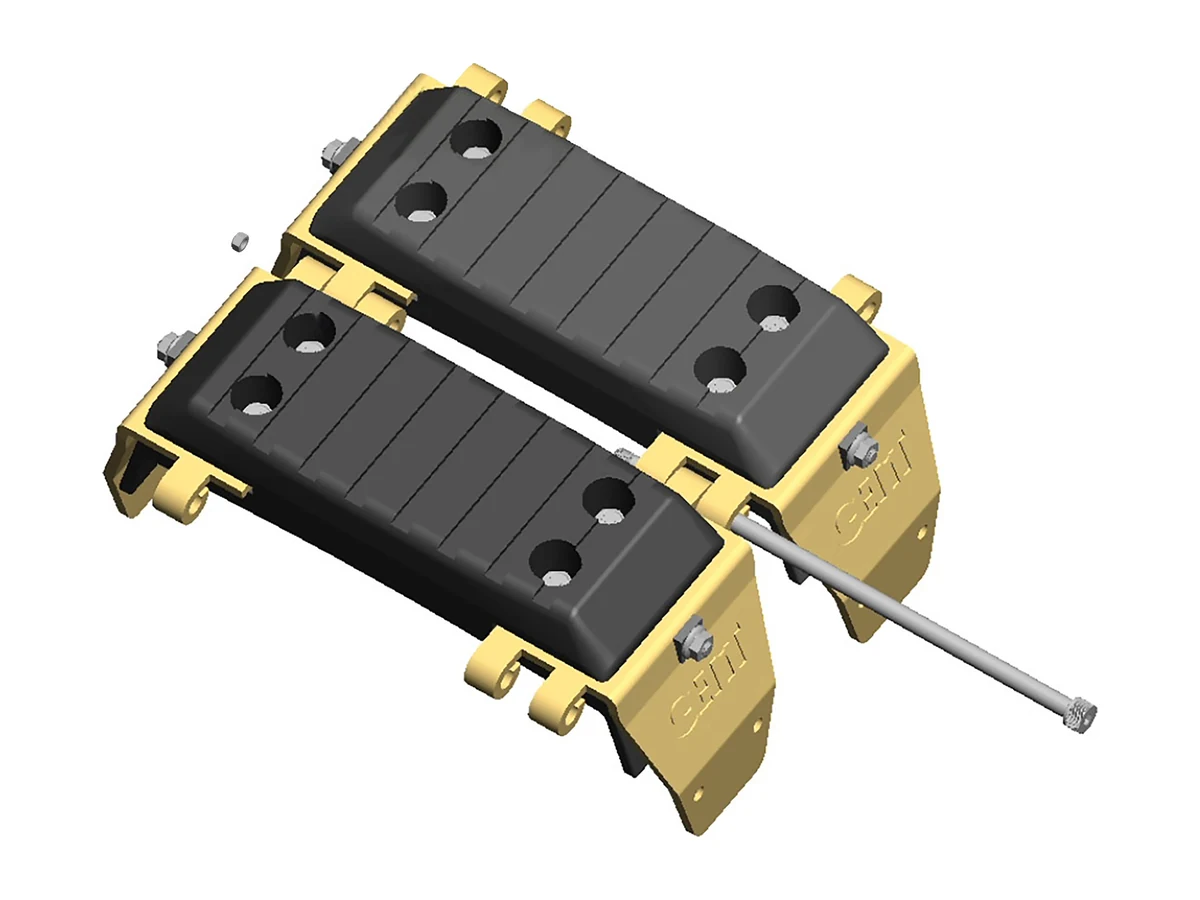
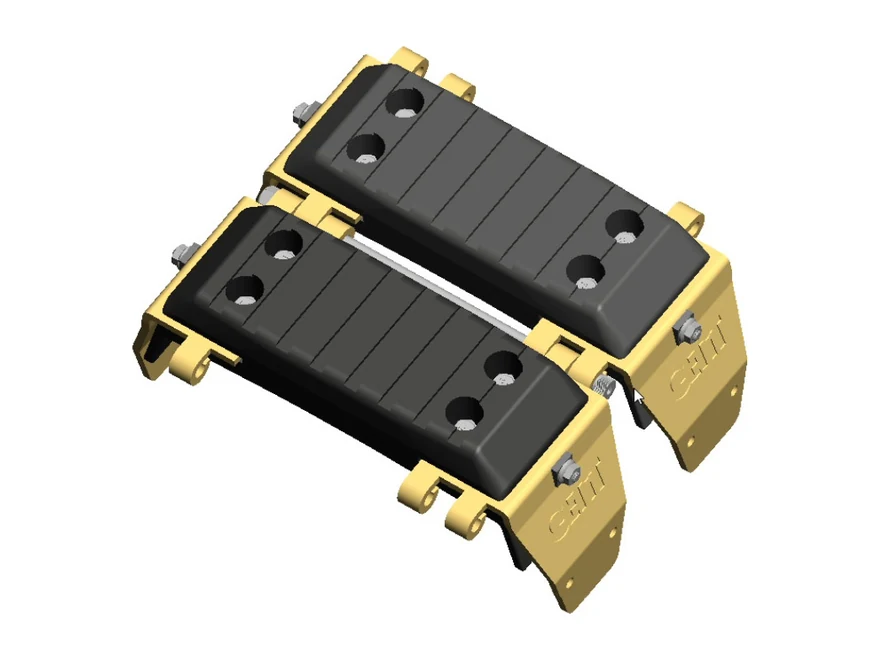
Because every link is bolted and pinned, a worn or bent one is changed on its own, and the track is made longer or shorter a link at a time.
Fitting it to the machineFOUR NUMBERS DECIDE THE FIT
An OTT track is sized to the tires and to the room around them, not to the machine's badge. Ten minutes with a tape measure saves a return.
Measure with the tires at their rated pressure and the boom down, at the tightest point you can find, not the easiest one to reach.
- ATIRE SIZE
Read it off the sidewall. 10-16.5 and 12-16.5 are the usual skid steer sizes.
- BWHEELBASE
Centre of the front hub to centre of the rear hub, in inches. It sets the length of the track.
- CSIDE CLEARANCE
Inside sidewall of the tire to the closest point on the frame. Plan on about 3 in. 2.5 in is the usual minimum.
- DCLEARANCE ABOVE THE TIRE
Top of the tire to the fender, boom arm or guard above it. The same rule: about 3 in, 2.5 in minimum.
Wheel spacers move the tire out from the frame; 2 in and 3.5 in are the common thicknesses. A smaller tire size is the other fix.
OTT tracks are made for pneumatic tires. Foam-filled and solid tires do not give, and that load goes into the track.
A track set up on worn tires is too tight on new ones, and one set up on new tires goes slack as they wear. Tell us what is on the machine.
SIX STEPS, ONE RATCHET STRAP
The short version of the job. Follow the instructions packed with your tracks for the hardware and torque they use.
- 1LAY IT OUT
Unfold the track flat in front of the machine, tread side down. Raise the boom and lock it.
- 2CHECK THE TIRES
Bring all four up to the pressure on the sidewall before you start.
- 3DRIVE ON
Roll slowly onto the track, centred, and stop when the machine sits in the middle of it.
- 4WRAP IT
Fold the back end up over the rear tire and the front end over the front tire.
- 5JOIN THE ENDS
Pull them together with a ratchet strap, fit the connecting link and tighten the hardware.
- 6SETTLE AND CHECK
Roll forward and back in a straight line, then check the sag. Add or remove a link if it is out.
Lay a straight edge across the top of the track from tire to tire and measure down to the track at the middle.
Too tight is worse than too loose: an over-tight track pulls the two axles toward each other.
Tires bed into the track in the first 20 hours. Re-check the tension a few times in that period, then about every 100 hours.
- Keep the pressure up
A soft tire bulges, rubs the side guides and wears through the sidewall.
- Turn wide
Make three-point turns instead of spinning on the spot. It spares the chains, the axles and the ground.
- Slow on hard ground
Steel on concrete or asphalt will mark it. Cross it straight and slowly, or take the tracks off.
- Walk round it
A loose bolt can work its way into a tire. Look over the hardware and the sag before each shift.
BEFORE YOU ORDER
Six answers that settle most OTT orders. Anything else, call us.
Will OTT tracks fit my skid steer?
Most skid steers on 10-16.5 or 12-16.5 pneumatic tires can run them. What decides it is the room around the tire: about 3 in between the tire and the frame, and the same above the tire. Send us the machine model, tire size, wheelbase and those two clearances and we will check it with you.
Do I need wheel spacers?
Only if the side clearance is short. Spacers bolt between the hub and the wheel and move the tire outward, usually by 2 in or 3.5 in. Some machines can get the same room by reversing the rims or running a narrower tire.
Can I use them with foam-filled or solid tires?
No. OTT tracks are made to run on air-filled tires. A foam-filled or solid tire does not flex, so the load that the tire would normally absorb goes into the track and its hardware.
Can I drive on concrete or asphalt?
You can cross it, slowly and in a straight line. Steel will scratch a hard surface, and turning or spinning on it grinds it. For long hours on pavement, take the tracks off.
How long does it take to put them on?
About 15 to 20 minutes a side once you know the routine, with a ratchet strap and hand tools. The first time takes longer because the length has to be set for your tires.
How tight should the track be?
It should hang 1 to 3 in between the tires, measured down from a straight edge laid across the top. Check it again several times in the first 20 hours, while the tires bed in, and then about every 100 hours.
SEND FOUR NUMBERS. WE MATCH THE TRACK.
- Machine make and model
- Tire size
- Wheelbase
- The two clearances
Call, or email them to sales@srjinc.com. 2242 Palmer Dr., Schaumburg, IL 60173.